
Most sales leaders are running the wrong calculation.
They are asking: how many of these roles can AI replace? The frame sounds like rigorous planning. But it is wrong in a specific way. The companies that stay inside that frame for the next eighteen months will be rebuilding what they cut.
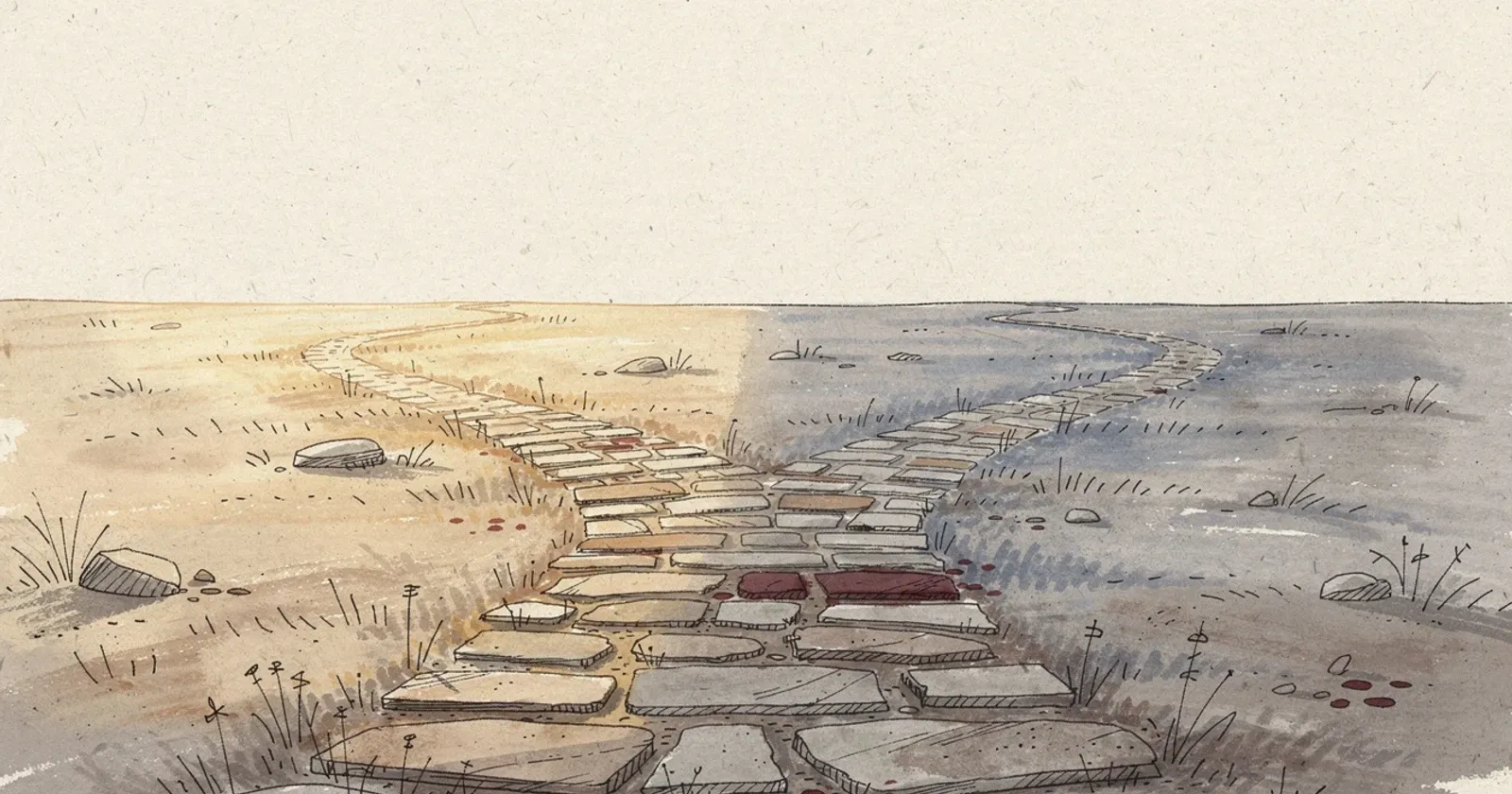
AI is not replacing B2B sales roles. It is splitting them. Every SDR, AE, and customer success role in a B2B company is bifurcating into two distinct functions. One handles the volume machine. The other handles the work that AI cannot win. The companies that design for both halves now will look very different from the companies that cut to the AI-only motion and wonder, two years from now, why complex deals stopped closing.
What bifurcation actually means for sales org design
AI does not eliminate B2B sales roles in the near term. It splits each role into a volume half and a human half. The two halves need different skills, different management structures, and different incentive designs. The volume half migrates toward AI-assisted automation. The human half grows in value as the AI side becomes commodity.
This matters because the two halves are not equally visible in a headcount budget. The volume half is exactly what a staffing model tries to cut: measurable work, standardized tasks, output that can be handed to a tool. The human half is harder to measure, harder to justify in a board-deck slide, and easier to cut because it looks like overhead. Cutting it is the mistake.
Think about what a typical SDR’s week looks like in 2026. Sequence variants. CRM field updates. Research summaries. Follow-up email drafts. Contact enrichment. This is 60 to 70 percent of the role on most teams, and AI handles it better, faster, and at lower marginal cost than a person. That portion is migrating. The teams that recognize it are not debating whether to cut it. They are asking who runs the machine after the human steps off.
The remaining 30 to 40 percent is not migrating. It is the specific account research that requires synthesizing a target’s conference talks, published writing, and LinkedIn activity into something that does not sound like a template. It is the personalized video that gets a reply because the prospect can see that a real person made it for them. It is the multi-thread campaign that requires someone reading the energy of a deal across six conversations and knowing when to push and when to wait. That work does not get cheaper or faster as AI tooling improves. It gets more valuable as the volume side commoditizes.
The AI in B2B sales question is not about how much of the role survives AI. It is about recognizing which half of the role you are building and building it deliberately. The mistake is treating the two halves as one job description and managing them with one set of metrics.
How the SDR role is already splitting
The SDR role splits earliest and most visibly because its volume half is the most standardized work in the sales org. Two new roles emerge from it. The AI Campaign Manager runs the volume machine. The Sales Development Specialist owns the 20 percent that AI cannot win. Both are full-time roles. Neither is the generic SDR job description from 2023.
The AI Campaign Manager builds, configures, and maintains automated outreach sequences. She monitors deliverability health, tests subject lines, adjusts targeting criteria when response rates shift, and feeds research from enrichment tools into the sequence logic. She is not a salesperson. She is an operations specialist who understands both the sales context and the tooling layer well enough to make the machine perform. She knows what a good sequence looks like but spends her day in the dashboard, not on the phone. The best person for this role has a strong operations instinct and a track record of making systems perform under pressure.
The Sales Development Specialist owns the conversations AI cannot resolve well. Specific account research. Personalized video. Multi-thread campaigns on deals where a generic sequence would be filtered, flagged, or ignored. The prospect who gets a personalized video from a rep who watched their last three conference appearances and references something real from their published work is receiving a signal that AI cannot replicate with the same fidelity. That signal is the point. The best person for this role has high verbal precision, genuine curiosity about the prospect’s actual situation, and a record of booking meetings through specificity rather than volume.
| Role | Primary focus | What success looks like | Personality fit |
|---|---|---|---|
| AI Campaign Manager | Sequence design, deliverability, tooling | Open rates, reply rates, sequence conversion | Operations-minded, systems thinker |
| Sales Development Specialist | High-value prospecting, personalized outreach | Meeting quality, pipeline generated per outreach activity | Judgment-driven, specific, curious |
These are different people. They have different motivations. They need different management. The AI Campaign Manager needs a manager who thinks in systems and optimization metrics. The Sales Development Specialist needs a coach who works on quality and precision. Most SDR managers right now are managing both types as one job description and wondering why the performance variance is so high. The variance has a name. The two types of reps are optimized for different halves of a role that has not been formally split yet.
How the AE role splits: from demo driver to deal architect
The AE role bifurcates more slowly than the SDR role because its volume side is more complex, but the split is already visible in teams that have been running AI-assisted discovery and demo flows for the last six months. AI can now run a standard discovery and demo sequence for lower-complexity deals with minimal human input. The AE’s value migrates to deals where trust, nuanced stakeholder management, and judgment under uncertainty are the variables that determine the outcome.
One AE track runs the standard deal motion. AI-summarized call notes pre-loaded into each subsequent call. Standard objection scripts. Automated follow-up cadences after each stage. Discovery templates that adapt based on prospect answers. This track handles deal volume and rewards process execution. The AE in this track runs the playbook cleanly, moves efficiently from stage to stage, and is measured on cycle time and conversion rate against quota.
The second AE track handles the deals that do not fit the standard motion. Enterprise deals with six or more stakeholders across multiple departments. Expansion deals where the account relationship has a complicated history. Competitive deals where the incumbent has a structural advantage and the question is whether the evaluation can even be reopened. This track requires the AE to be a deal architect rather than a demo driver. She needs to understand the internal politics of the account, know which stakeholders trust each other, and run the kind of multi-touch engagement that requires reading the room across a dozen conversations over multiple months.
| AE Track | Deal type | Primary skill required | AI contribution to the motion |
|---|---|---|---|
| Standard motion | Mid-market, defined complexity, clear champion | Process execution, clean handoffs | Runs discovery summaries, drafts follow-ups, flags at-risk signals |
| Deal architect | Enterprise, complex, competitive, high-stakes | Stakeholder judgment, political mapping | Supplies research and call notes; human runs every play |
The companies that only build the standard-motion track will convert mid-market deals and miss enterprise. The companies that only build the deal architect track will leave transactional volume on the table. Both tracks are necessary. The mistake is assuming the existing AE team can run both motions under the same management model.
How the CS role splits: from ticket resolver to strategic advisor
Customer success bifurcates in the same direction as SDR and AE, but the split happens at a different point. AI absorbs the support and monitoring layer: tier-1 tickets, health-score tracking, renewal summaries pre-populated with product usage data, and QBR first drafts generated from account data. The human CS role that remains is not a support function. It is a strategic relationship function, and the two are not interchangeable.
The support-layer work was always the part of CS that was hardest to make feel strategic. The rep who spent three hours a week triaging integration questions was not doing work that required human judgment. That work migrates.
What remains requires a person in the room. Running executive business reviews where the economic buyer is present and the conversation is about strategic goals, not feature questions. Identifying the expansion opportunity that does not show up in product usage data but surfaces in an offhand comment from an account stakeholder about a new initiative. Coaching that account team on the highest-value use of the product, which requires understanding their internal goals and org politics, not just their product behavior. Owning the renewal conversation with the person who has authority to cancel, where the relationship history and current trust level determine the outcome.
This is a real skills shift. Most CS teams are not hiring for strategic advisory skills. They are hiring for patience with support volume, technical fluency, and the ability to manage a high-volume ticket queue. The managers who redesign the CS role now will have a team positioned for the shift in eighteen months. The ones who wait will still be managing the support queue when the support queue gets handed to AI.
Harvard Business Review’s research on B2B buying documents that purchase decisions in complex B2B deals increasingly involve more stakeholders and longer timelines than five years ago. The CS role that survives this environment is the one that can operate as a strategic advisor to multiple stakeholders, not a support ticket resolver who happens to be assigned to an account.
Why “how many can we cut” leads to the wrong outcome
The sales leaders who frame AI adoption as a headcount reduction question are making a specific error. They are correctly identifying that the volume half of each bifurcated role can be handled by AI. Then they conclude that the role itself is eliminated. The human half does not make it into the calculation.
What the cut-and-automate motion produces is not a cheaper equivalent of the existing team. It produces a sales function that can compete on volume. Volume is commodity in 2026. When every competitor has access to the same AI outreach tooling at approximately the same cost, the differentiation collapses to who executes the human layer better. The company that cut the human layer to fund a larger volume machine has no answer to that question.
I wrote about this in the previous essay on AI as a management problem: the bar for generic outreach did not go down when AI sequencing tools became widespread. It collapsed. The tools gave every team the same capability at the same cost. The reps who were winning on volume efficiency stopped winning. The reps who were winning on specificity, judgment, and human connection kept winning. AI made the volume game lower-margin, not lower-effort.
Cutting the human layer to fund a pure volume machine is not an upgrade. It is a bet that volume beats specificity in a market where the floor of volume-based outreach is already collapsing under the weight of AI-generated sameness. The cost of being under-automated on the volume side is inefficiency. The cost of being under-invested on the human side is deals that do not close, customers that do not renew, and a market position that looks acceptable in a trailing-twelve-months view and shows its brittleness in month thirteen.
The asymmetry of cost here is the same asymmetry that makes the no-list the first artifact in any AI deployment. One direction produces friction. The other direction produces damage that is hard to measure and slow to show up, which is why it keeps getting underestimated.
What to do now: the practical org design moves
The practical question for any sales leader right now is concrete. Which two roles should each current role become, are you building toward that structure now, and do you have a plan for the reps who will end up in the wrong half of the split?
The first move is an audit. Go through your current SDR team and separate the reps into two groups based on what they are best at and most motivated by. The reps who are strongest at operations, tooling, and systematic optimization become the foundation of the AI Campaign Manager role. The reps who are strongest at specific research, human conversation, and judgment-driven outreach become the foundation of the Sales Development Specialist role. You almost certainly have both types on payroll already. You are probably managing them identically and wondering why the performance variance is so high. The variance has a name now.
The second move is to invest in the capabilities the human half needs that AI tooling does not provide. Personalized video for B2B is the most visible example. A rep who sends a personalized video that references something specific about the prospect’s work, their conference talk, their company’s recent initiative, is doing something that requires research, judgment, and a decision about what will resonate. The prospect who receives it knows a person made it for them. That knowledge changes how they respond, and it cannot be replicated at scale without degrading the signal that makes it work.
The third move is to build separate management structures for the two tracks before the split happens rather than after. The AI Campaign Manager needs a manager who thinks in systems, metrics, and optimization loops. The Sales Development Specialist needs a coach who works on precision, specificity, and the judgment calls that determine whether a campaign gets a reply or gets ignored. These are genuinely different management skill sets. Right now most SDR managers are trying to do both, and one track is always being under-served.
From an operator’s perspective, the temptation is to let the market pressure make the decision for you: wait until the underperformance is undeniable and then reorganize. The problem with that approach is that the human half of each bifurcated role takes time to rebuild. The judgment that accumulates in a Sales Development Specialist who has been doing this work for twelve months does not transfer to a new hire. The volume machine can be stood up in a quarter. The human layer that makes it matter cannot.
The compounding reason to start in 2026
The human half of each bifurcated B2B sales role has a compounding property that the volume half does not. A Sales Development Specialist who has been doing specific account research and personalized video outreach for twelve months has developed judgment and pattern recognition that is not transferable to a new hire and not replicable by a tool. She knows which signals in a target account’s public output predict deal quality. She has built a personal reputation in the market she is working. The relationships she has opened compound into the relationships she will close next year.
The volume machine does not compound in the same way. It improves incrementally as the tooling improves, but every competitor on a similar tooling stack has approximately the same capability. The differentiation in the volume machine is in the configuration and optimization, which are real skills but are much closer to commodity than the judgment skills on the human side.
The AI 2027 forecast describes late 2026 as the moment when the split becomes visible in competitive outcomes. Teams that invested in the human layer are outperforming on complex deals. Teams that went AI-only are competitive on simple deals and invisible in the segments where deal size and margin are highest. The split that started as an org design question becomes a market position question eighteen months later. By the time the outcome is visible, the companies that waited have a twelve-month deficit in human-layer capability that is not solved by a hiring sprint.
McKinsey’s research on AI adoption and workforce transformation shows that the companies pulling ahead on AI-enabled workflows are not the ones with the most aggressive automation. They are the ones that identified which decisions still require human judgment, protected those capabilities while automating the routine work around them, and built the integration between the two halves deliberately. That is the bifurcation thesis in practice. Automate the volume half. Invest in the human half. Manage them as distinct functions with distinct success metrics and distinct management models. The companies that do this first are building a structural advantage. The companies that cut to the AI-only motion are building a faster commodity machine.
The closing thought
Every technology shift rewards a different kind of human judgment than the one before it. The CRM era rewarded the pipeline manager. The outbound tools era rewarded the volume driver. The AI era rewards the sales professional who can do the work that AI cannot do at scale: specific, judgment-intensive, relationship-grounded work that signals human effort in a market flooded with AI-generated sameness.
This is a less familiar answer than “AI will eliminate half the roles.” It is more useful. The people who match the profile for the human half of each bifurcated role are quietly already in your building. Some of them have been outperformed on volume metrics by reps who were running more sequences. The volume metrics are about to matter less. The judgment metrics are about to matter more.
More on this at dearmer.com.au, including the question of what happens to founder lessons when the same bifurcation plays out in the operations and marketing functions as well. The thesis does not stop at sales.
If you are running an SDR team right now, here is the specific question worth sitting with this week: of the reps currently on your team, which three would you keep in their current seats if the only pipeline in the next twelve months came from deals where human judgment was the deciding factor? Those three are your foundation for the human half of the bifurcated model. The question is whether you are building the structure around them or waiting for the pressure to make the decision for you.
Frequently asked questions
Is AI going to eliminate B2B sales jobs over the next two years?
Not eliminate, but reshape. The volume half of every sales role is moving to AI-assisted automation. The human half is becoming more valuable, not disappearing. Companies that cut the human half to run a pure volume motion will find themselves without the judgment layer needed for complex, high-value deals and renewals in the segments where margin is highest.
What is the bifurcation thesis for B2B sales roles?
The bifurcation thesis holds that AI does not replace sales roles wholesale. It splits each role into two. One half handles the volume machine: sequencing, research summaries, draft emails, CRM updates. The other handles the work AI cannot win: nuanced account research, personalized video, high-stakes relationship management, and complex multi-thread campaigns.
What does the SDR role look like after AI bifurcation?
Two roles emerge from the SDR role. The AI Campaign Manager builds and maintains automated outreach sequences, monitors performance, and optimizes at scale. The Sales Development Specialist does specific account research, records personalized video, and manages complex multi-thread conversations that require judgment. Both are full-time roles with different skills and different management needs.
Should I cut SDR headcount and replace those reps with AI tools?
Cutting headcount to run the AI-only motion eliminates the human half of the split, which is exactly where trust is built and complex deals are opened. Companies that make this cut will need to rebuild the human layer when they discover that commoditized outreach produces commoditized results in a market where every competitor has access to the same AI tooling.
How does the AE role change as AI handles more of the standard deal flow?
The AE role splits into two tracks. One handles AI-assisted standard discovery and demo flows for lower-complexity deals, rewarding process execution. The other handles enterprise and competitive deals where trust, stakeholder nuance, and judgment under uncertainty are the decision variables. Both tracks need humans. The skills, management, and incentives each track needs are genuinely different.
What should a sales leader do now to prepare for role bifurcation?
Audit your current team to identify which reps have operations instincts and which have judgment and specificity. Build separate management structures for the two tracks. Invest in the capabilities the human half needs, particularly personalized video. Stop hiring generic SDRs and start designing the two roles that will replace them in your next headcount plan.
How does personalized video fit into the bifurcated B2B sales model?
Personalized video sits firmly in the human half of the split. It requires research, judgment about what will resonate with a specific person, and a production signal that tells the prospect a person made it for them. AI can assist scripting, but the prospect can tell the difference. That difference is exactly why personalized video gets more valuable as AI volume outreach becomes commodity.
Sources & references
- AI 2027 Forecast · The scenario forecast that documents late-2026 job market bifurcation: 'the AIs can do everything taught by a CS degree, but people who know how to manage and quality-control teams of AIs are making a killing.' Directly informs the B2B sales role split analysis in this essay.
- McKinsey on AI and the Future of Work · Research on how AI adoption reshapes workforce structure, with evidence that high-judgment, relationship-intensive roles increase in value as automation handles routine task volume across knowledge-work functions including sales.
- Harvard Business Review on B2B Sales Transformation · Documents the shift in B2B buying toward longer decision cycles, more stakeholders, and higher trust requirements, creating the market conditions that make the human half of bifurcated sales roles more valuable as buyer sophistication increases.
- Anthropic — Alignment Research · Primary research on why AI agents require human oversight at the judgment layer. Reinforces the argument that the human half of bifurcated sales roles is not optional overhead but necessary infrastructure for high-stakes decisions and customer-facing work.
- OpenAI — Chain-of-Thought Monitoring · Documents that even the most capable AI models require careful human review of complex outputs, relevant to why the Sales Development Specialist and deal architect roles cannot be fully replaced by AI in contexts where trust and specificity are the deciding variables.